


OFC 2026 – Optical Networking for AI Data Centers: Technology Enablers and Key Applications – NTT, NVIDIA, Ciena, Lumentum, iPronics, nEye Systems
Introduction
As demand for AI supercomputing explodes at 2.5X per year (16-bit FLOP/s), traditional Ethernet and electrical-switching architectures are running into severe power and cost bottlenecks. At this core OFC 2026 workshop, industry leaders converged on one key consensus: Optical Circuit Switching (OCS) is no longer the preserve of long-haul telecom; it is becoming the foundational architecture that lets AI data centers scale beyond 100,000-GPU clusters. The session explored how OCS is evolving from a "static patch panel" into a core node for "dynamic topology optimization," and laid out volume-production timelines for next-generation MEMS, silicon photonics (SiPh) and programmable optics.
Core Technologies: What Each Company Said
During the panel, the companies showed clear strategic differences on the role of OCS in AI clusters:
1. NTT (Kazuya Anazawa): Putting the APN All-Photonics Network into Practice
Core position: NTT's IOWN APN (All-Photonics Network) architecture aims to extend optical paths all the way to the server.
Key data: NTT highlighted that the number of AI chips is growing 1.6x per year. It believes OCS can significantly cut end-to-end latency and power, especially for large-scale cross-cluster interconnect, with the goal of bringing per-bit transmission power down to the pJ/bit level.
Technical path: A focus on highly reliable optical switching technology to support flexible scaling of future AI supercomputers.


2. NVIDIA (Giannis Patronas): Topology Flexibility and Fault Tolerance
Core position: NVIDIA takes a pragmatic yet forward-looking stance on OCS adoption. OCS is not meant to replace InfiniBand or Spectrum-X, but to act as a "topology enhancer" in their interconnect layer.
Technical data: NVIDIA discussed introducing OCS into Dragonfly and Fat-Tree topologies. In NVIDIA's view, OCS's core value lies in:
Topology reconfiguration: dynamically adjusting direct network paths based on the training job (e.g., LLM vs. recommender systems).
Fault tolerance: when a fiber or module fails, OCS can quickly reroute traffic, avoiding costly idle time on the GPU cluster.
Where it differs: Unlike vendors chasing microsecond-level switching, NVIDIA currently cares more about OCS's stability as a tool for large-scale cluster management (software orchestration).


3. Ciena (David Boertjes): Leading in High-Radix Switching
Core position: Bringing carrier-grade optical switching technology inside the data center.
Technical target: Ciena is developing ultra-high-radix OCS systems, aiming for single-unit switching with 1,000+ ports to reduce the number of optical-electrical-optical (O-E-O) conversions.
Outlook: Optical-layer transparency inside data centers is expected to rise sharply over the next 12-24 months.


4. Lumentum (Peter Roorda): The Component Leader in MEMS and LCoS
Core position: Offering a diverse set of underlying switch technologies, including MEMS and LCoS.
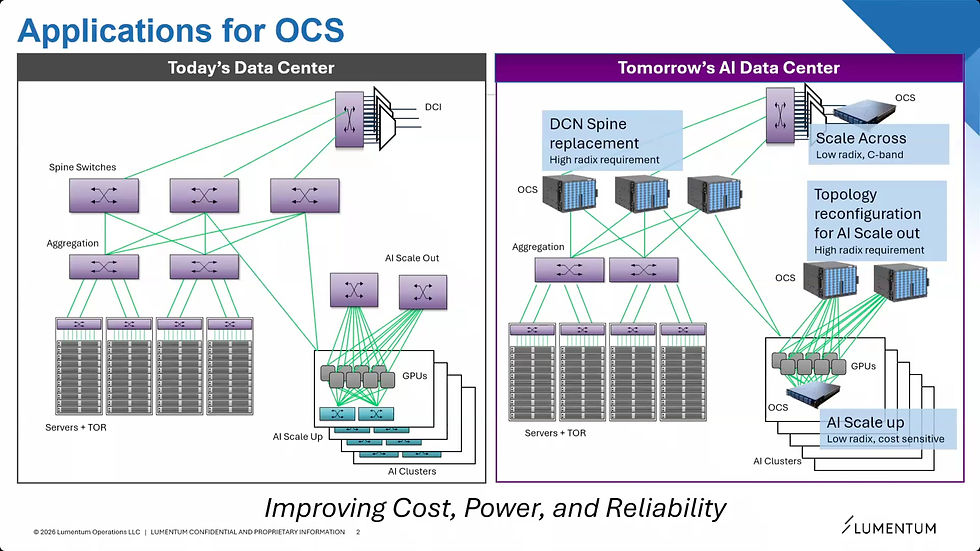
Key view: Lumentum noted that OCS is evolving from traditional telecom WSS (wavelength selective switches) into lower-cost, high-density packaged modules better suited to AI.
Head-to-head data: Lumentum stressed that MEMS holds a decisive advantage in insertion loss and reliability, making it the most mature solution on the market today.



5. nEye Systems (Ming Wu): 3D MEMS and Ultra-Low-Loss Technology
Core position: Championing 3D MEMS technology to achieve sub-microsecond switching speeds.
Key data:
Switching time: demonstrated switching response below 500 ns.
Loss control: moving-waveguide technology achieves zero loss in the OFF state while keeping crosstalk extremely low in the ON state (crosstalk < -60dB).
Competitiveness: Its 3D OCS architecture supports 143 or more channels without additional SOA amplification, significantly reducing system complexity.


6. iPronics (Luis Torrijos): Software-Defined Optics and Programmable Photonics
Core position: Promoting an optical-FPGA-like programmable photonic chip (PPC).
Technical advantage: A silicon photonics (SiPh) mesh architecture enables ultra-fast, software-defined optical path configuration, well suited to edge AI applications that frequently rebalance compute resources.


Consensus and Divergence
Consensus on technology paths: All participants agreed that silicon photonics (SiPh) and MEMS are the two pillars for scaling OCS.
Divergence on switching speed:
Traditionalists (Ciena, Lumentum): millisecond-level switching is more than sufficient for topology reconfiguration and fault tolerance.
Radicals (nEye Systems, iPronics): switching must reach sub-microsecond levels to enable an early form of "optical packet switching" in the future.
Power and thermals:
Participants agreed that OCS itself consumes almost no power (passive switching); the SONiC system and processors in the management/control plane account for most of the power.
2026E outlook: As density rises 10X, thermal management (rather than liquid cooling) will become the next technical challenge for OCS packaging.
Supply Chain and Market Impact: The Simple Tech Trend View
From a supply-chain perspective, the session sent several important signals:
TSMC and the packaging side: As iPronics, nEye and others push higher-density OCS, the integration of CPO (co-packaged optics) and advanced packaging (CoWoS) may extend beyond DSPs and optical engines to include miniaturized MEMS arrays in the future.
Optical transceiver makers must transform: Traditional pluggable modules face a double challenge from LPO (linear drive) and OCS. Wider OCS adoption will reduce the number of electrical-port modules needed for middle-tier switches, which is both a margin challenge and a push toward technology upgrades for the major module makers.
Software ecosystem (SONiC): Network softwarization has become the "ticket" for OCS to enter the data center. How seamlessly each OCS vendor integrates with existing data center network architectures (such as Google's Apollo system) will determine its market share.
STT trend outlook (2025-2027): We expect OCS to move over the next 18 months from Google's exclusive secret weapon into the labs of Tier-2 CSPs, reaching small-volume production by the end of 2026. NVIDIA's strategic entry (even if only for topology management for now) will greatly boost market confidence in OCS. Investors should closely watch companies with MEMS precision-packaging capabilities and silicon photonics integration technology.


Comments