


ECOC 2026 | A 1,024-Lane Switch Stuck at 0.07 T/mm: Huawei Says NPO Isn't "LPO Moved onto the Board" — It's a Full Switch Redesign
Youxi Lin of Huawei's data communication product line gave a rare kind of talk at ECOC 2026 — one that looked at optics not from the optical module's point of view, but from the switch's: what optics should look like. His numbers were very concrete: if module makers chased every possible path, they would need to develop more than 50 module SKUs; and as switches move toward 1,024 lanes, today's OSFP beachfront density is only 0.07 T/mm and back-to-back insertion loss at 53 GHz is 32 dB, while the targets are >0.3 T/mm and <22 dB — more than 4x the density, and another 10 dB of loss to cut. His conclusion was blunt: NPO is not "moving an LPO module onto the board" — it requires redesigning the entire switch system, from sockets and thermals to in-chassis fiber routing and PI/SI design. And Huawei already showed a 51.2T NPO switch at CIOE 2026: 16 3.2T SiP optical engines at under 23 W each, 16 ELSFPs at under 9 W each, over 20% system-level power savings, and interoperability with pluggable DPO modules.
1. Where He Stands: This Is a Scale-Out Talk
The speaker framed the scope right away: his product line builds both switches and pluggable modules, and this talk focuses on scale-out — the optical links from NIC to switch and from switch to switch.
The slide spells out the configuration:
Switch side: 128×800G or 64×1.6T, moving toward 3.2T
GPU side: 8×100G today, evolving to 8×200G
In-rack distance: under 4 meters
Media: MMF and SMF coexist; switch-to-switch links use WDM optical modules
He then ranked "how AI compute priorities steer the optical network" in a rather opinionated order:
Resilience > IO density > Power > Latency > Cost
This ranking is worth noting. Putting resilience ahead of density and power is a system vendor's perspective, not a component vendor's. Component vendors sell pJ/bit and T/mm, but the first question from anyone buying a whole switch is "what happens when it breaks?" On the same slide he added a call on scale-up: scale-up will remain copper in the near term, but will eventually move to optics.
2. More Than 50 SKUs: "A Happy Problem"
The second slide is, in my view, the one the industry most needs to see. Its title reads: "Key challenges of optical interconnect — a happy problem", with the subtitle:
If one follows every possibility, one can enjoy developing more than 50 module SKUs.
The chart lays the options out in four layers:
Package / form factor: OSFP, QSFP, XPO, HIONE, CPX, UPO, SNPO, CPO, OIO…
Retiming scheme: DPO, LRO, LPO
Modulator material: VCSEL, EAM, silicon photonics, TFLN, BTO…
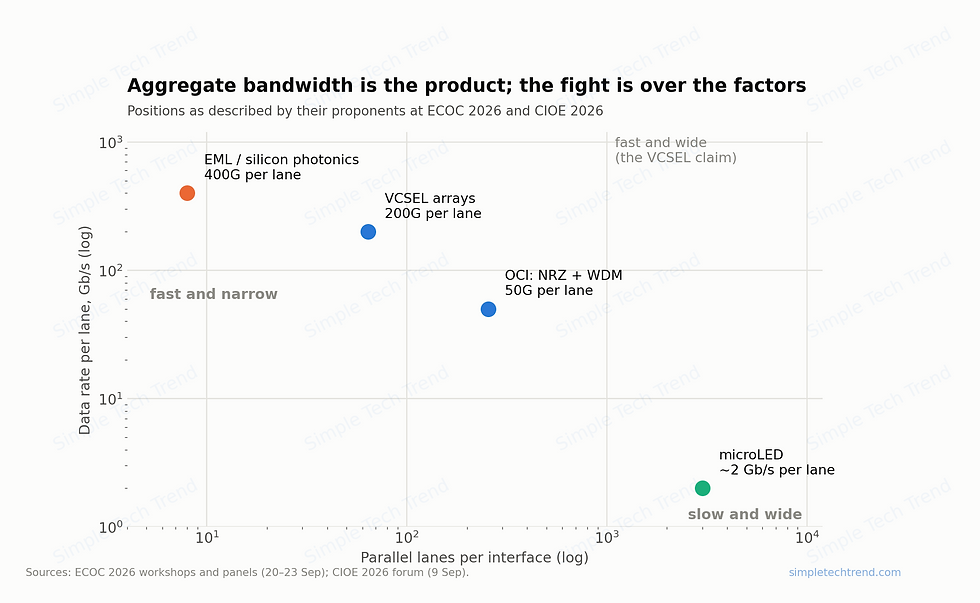
Modulation format: PAM4 (fast & narrow), NRZ (slow & wide)
The left column lists the drivers: resilience, cost, density, power, performance.
Multiply out the four layers and you get that number 50. For switch makers it's a multiple-choice question; for module makers it's a capacity and R&D disaster — and every option has someone pushing an MSA, each claiming to be the standard.
The speaker's stance was clear: we have to make choices. He noted that NPO alone already has HIONE and the CPX MSA, while Chinese end customers have defined UPO and XPO on top of that.

3. The First Rule of Choosing: Time-to-Market
So how do you choose? His first rule is time-to-market.
The slide's speed mapping is clean:
400G: 50G/lane SerDes
800G: 100G/lane SerDes
1.6T: 200G/lane SerDes
3.2T: 400G/lane SerDes
Then four judgments:
Pluggables remain mainstream in scale-out networks
LRO will gradually replace DPO
LPO still has to prove itself beyond 100 Gbps
Once you move to LRO/LPO, optical modules become increasingly dependent on the switch
That last point foreshadows the rest of the talk. When you remove the DSP from the module (or cut half of it), the burden of equalization and compensation shifts to the SerDes on the switch side. Hence his remark: "We build switches, so let me remind you — this makes you more dependent on the switch."
We covered LPO's failure to deliver at 1.6T in 2026 OCP APAC Summit | Edgecore × NTT ID | LPO Turned In a Blank Page at 1.6T, Pulling the CPO Timeline Forward a Generation — Huawei's view here is essentially the same judgment, phrased differently.
4. The 224G/L Generation: VCSEL Isn't Out Yet
The speaker devoted an entire slide to VCSEL, titled: "224G/L: VCSEL DPO is technically feasible and cost-effective below 50 meters."
Three arguments:
850 nm VCSELs are technically feasible for 200G/lane applications
VCSELs are a cost-effective solution for short reach
Standardization and industry acceptance will determine final deployment scale
The reach comparison: in the 100G generation, VCSEL reached about 100 m vs. silicon photonics; in the 200G generation, VCSEL reach shrinks to 30–50 m.
Measured results sit at the bottom of the slide: eye diagrams after FFE equalization, plus back-to-back and 30 m OM4 multimode fiber link measurements.
Taiwanese suppliers should pay attention here. For 200G VCSEL, the question isn't "can it still be used" but "how far can it reach" — and the answer has dropped from 100 m to 30–50 m. With in-rack AI distances already under 4 m, a 50 m ceiling is more than enough for scale-up and in-rack scale-out. For Broadcom's progress on this path, see Technical Analysis | Broadcom 200G VCSEL Deep Dive: NPO, the "Power-Saving Weapon" for AI Scale-Up Networks.
The speaker himself said Huawei will keep contributing to standardization so VCSEL gains wider acceptance. That's a statement of position, not just a technical comment.
5. The 448G/L Generation: Electrical Choices Will Hold Optics Hostage
One generation further, the tone changes. The title: "448G/L: it will span several generations, with optics and electrical deeply coupled."
Three hard constraints:
Electrical connector bandwidth limit is beyond 112 GHz (for PAM4)
448G/L needs a new pluggable form factor
If PAM6 is chosen, 3.2T transceiver power consumption will be a challenge
Then comes the efficiency ladder — "bandwidth doubles, power efficiency improves 25–30%":
800G: DPO 20 pJ/b; LRO 12.5 pJ/b
1.6T: DPO 15 pJ/b; LRO 10 pJ/b
3.2T: DPO ?; LRO ?
Those question marks are the point of the slide. Each past generation relied on a 25–30% efficiency gain to absorb doubled bandwidth, which kept absolute power from exploding. But at 3.2T, if the electrical side picks PAM6 instead of PAM4, a gearbox is required, and the speaker said flatly, "we don't think DPO power can beat the previous generation" — meaning that steadily falling curve may bend upward for the first time.
This is a risk that is rarely stated outright: the two-decade intuition that "each new generation is more efficient than the last" may break at 3.2T. And what decides it isn't optics but the electrical modulation format. On his conclusion slide he put it more bluntly: PAM4 is by far the better choice.

6. 1,024 Lanes: This Slide Is the Core of the Talk
The speaker opened with one line: "Everyone thinks NPO is just LPO on the board. I don't think so, because it's much more than that."
His reasoning has two layers.
The first layer is loss. The original motivation for NPO is removing the extra channel loss — moving the optical engine close to the ASIC eliminates the long electrical trace in between.
The second layer is density, and this is the real bottleneck. The slide's subtitle reads: "For a 1024-lane NPO switch, density is everything."
Two sets of numbers side by side:
Back-to-back insertion loss (@53 GHz):
OSFP: 32 dB insertion loss
OIF-3.2T: 24 dB insertion loss
Target: insertion loss < 22 dB
Unidirectional beachfront density:
OSFP: 0.07 T/mm
OIF-3.2T: 0.256 T/mm
Target: density > 0.3 T/mm
Going from 0.07 to 0.3 is more than a 4x density increase; going from 32 dB to 22 dB means cutting 10 dB. And these are two sides of the same coin — only optical engines with high beachfront density can push insertion loss down, because higher density means shorter, fewer electrical traces per lane.
Then comes the list the speaker called a "systematic engineering upgrade":
A new socket must be defined on the board
The switch needs a new thermal solution
In-chassis fiber routing must be handled
NPO optical engines need new PI/SI (power integrity / signal integrity) design
His summary: "This is something entirely new for switches." And an equally important line: 6.4T optical engines need converged standardization to be cost-effective — echoing the earlier "more than 50 SKUs" problem.

7. Not Just Theory: A 51.2T NPO Switch That Interoperates with Pluggables
After the theory, he showed a machine.
A 51.2T NPO switch shown at CIOE 2026, demonstrating interoperability with pluggable DPO modules. The slide lists the specs:
64 MPO16 APC connectors
16 3.2T silicon photonics optical engines, compliant with the OIF 3.2T co-packaged optics specification and ODCC specifications
16 ELSFPs, each under 9 W
Optical engine power under 23 W
TP2 compliant with IEEE 802.3
Receiver sensitivity −7 to −9 dBm @ BER 1e-6
Over 20% system-level power savings
The two measurement charts below are worth a look too: all TDECQ values fall under the 3.4 dB threshold of the LPO MSA / IEEE 802.3; and the BER distribution across 512 lanes is three orders of magnitude below IEEE's tightened 1e-6 spec.
There's an easy-to-miss but critical design choice here: this NPO switch is "pluggable," deliberately built to interoperate with standard DPO modules.
Why does that matter? Because NPO's biggest commercial risk has never been technology — it's lock-in. Once optical engines are soldered to the board and only talk to the vendor's own modules, customers are locked in. By proving on the show floor that "my NPO switch can take your DPO modules," Huawei is answering the question hyperscalers worry about most.

8. Slow and Wide: Another Path Beyond 224G/L — But Not Ready Yet
The last slide covers slow-and-wide, titled: "Besides fast & narrow, there are slow & wide options beyond 224G/L."
The fork between the two paths is drawn clearly:
Fast & Narrow: 100G/L → 200G/L → 400G/L, host side connects directly to SerDes
Slow & Wide: 4×50G/L → 8×50G/L, using a comb source
The targets:
Power (including SerDes and laser): ~10 pJ/bit → 4 pJ/bit
Density: 0.5–1 T/mm → 2 T/mm
Note that 2 T/mm — it's more than six times the 0.3 T/mm NPO target above. That's why slow-and-wide deserves serious attention: it's not incremental improvement but a jump in order of magnitude.
But the speaker's three caveats were equally clear:
Slow-and-wide optics mainly address the limits of ultra-high-bandwidth SerDes
Interoperable optical interfaces are required before broad acceptance in scale-out networks
Slow-and-wide requires further engineering upgrades on top of NPO, especially in packaging and reliability
He stressed "interoperable" twice. For scale-out it's a hard requirement — whether black-box form factor or open ports, scale-out networks need interoperable interfaces. This fast-narrow vs. slow-wide split was argued for three hours at another ECOC 2026 workshop without consensus; we covered it in ECOC 2026 | Fast-Narrow vs. Slow-Wide Argued for Three Hours, and Nobody Defined "Slow" First: The Real Dividing Line Is 448G.
9. Conclusion
Put this talk alongside others from the same week and a consistent signal emerges: the hardest-hitting statements at ECOC 2026 came not from optics vendors but from optics buyers. Corning talked FAU reliability, the EBO MSA talked connector contamination, Lumentum talked laser power thresholds, and Huawei's talk was about this — as switches reach 1,024 lanes, existing optical interfaces fall more than 4x short on density.
For Taiwan's supply chain, three concrete takeaways:
First, the 0.07 → 0.3 T/mm gap is a clear order map. Beachfront density can't be solved with a better laser or a better DSP — it's a problem of packaging, connectors and optical engine structure. MPO16 APC, high-density FAUs, on-board optical sockets, in-chassis fiber routing — Taiwanese companies work on each of these, and all of them are being repriced because of this number. When one switch needs 64 MPO16 APC connectors, the connector is no longer an accessory; it's a lead item on the BOM.
Second, ELSFP <9 W and optical engine <23 W are more useful references than any roadmap. Because they aren't targets — they're values measured on a machine that has already been built. Taiwanese suppliers quoting ELSFP specs now have a baseline to match against, instead of everyone's own version of "low power."
Third, and most worth remembering — the 3.2T question mark. Each past generation absorbed doubled bandwidth with a 25–30% efficiency gain, but if 448G/L goes PAM6, that rule may fail for the first time. For Taiwanese optical module makers, this means the competitive threshold in the 3.2T generation isn't optics but whether they can help customers get the electrical-side choice right; for Taiwanese makers of NPO/CPO-related structural parts, it's actually good news — the harder it is for pluggables to keep scaling, the sooner on-board solutions arrive.
Verdict: The real value of Huawei's talk isn't that it gives answers, but that it reframes the question from "which optical solution is better" to "what does the switch system need." When the density gap at 1,024 lanes is 4x, insertion loss must drop another 10 dB, and there are 50 optical module SKUs to choose from, the winner won't be the most technically elegant option — it'll be the first one to converge into a standard.
This article is for technology and industry trend analysis only and does not constitute investment advice.
Related Reading
After Copper Runs Out for AI: Seven Paths for Scale-Up Optical Interconnect, and Two Ways to Survive Each Bottleneck: a full breakdown of the fast-narrow vs. slow-wide yardstick
ECOC 2026 | Data Centers Need Billions of Lasers, but the Bottleneck Is the 5 Minutes It Takes to "Connect" Them: the light-source workshop at the same ECOC — the other side of the density and packaging bottleneck


Comments