


2026 OCP APAC Summit | Coherent | Anna Tatarczak | 400G/lane Is Bottlenecked by Electronics, Not Optics: IM/DD Isn't Done Yet, but Packaging Has to Save It
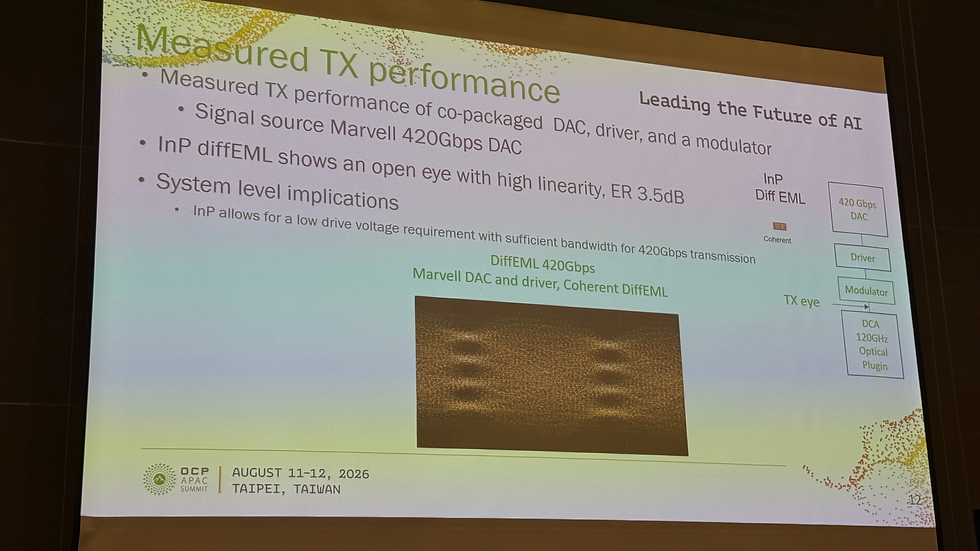
Anna Tatarczak of Coherent's CTO office presented a set of 400G/lane measurements at OCP 2026 APAC: an InP EAM paired with a BiCMOS driver produced a 420 Gbps eye, with end-to-end BER below 1e-4. Technically, it “can” be done.
But what she actually spent the talk on wasn't the modulator — it was the interfaces: wire bond and flip chip have similar losses below 110 GHz, and above that things “suddenly collapse”; today's OSFP connector has a frequency dip at 90 GHz. The optical components arrived first, while electrical and packaging lag a step behind — that is the real shape of the 400G/lane generation.
On materials, the field isn't converging — it's diverging: SiPh, InP and TFLN each have their blind spots. The sharpest number: a TFLN modulator is roughly 100x the area of an InP EML, which cuts it straight out of high-density CPO scenarios.
Reach is the dividing line: a single 400G/lane wavelength goes about 2 km, while CWDM drops to just 500 m (extendable to 1.5 km with DSP or optical dispersion compensation). Coherent-lite's reason to exist is to buy back those 2 km while removing the entire dispersion-compensation block from the DSP.
For 600G/800G, her view is that IM/DD can still hold: lower power, lower cost, simpler receiver; modulators and PDs “already exist in the literature” — what's missing is the electronics. She closed the door on PAM6 in optics with one sentence: the SNR wall is still there.
1. Why Talk About 400G/lane Now: The Question Has Already Changed
100G/lane is already running and 200G/lane is being deployed. Nobody at OCP needed convincing of that, but the implication is often skipped: when doubling the lane rate becomes routine, what really gets squeezed isn't the optics — it's the margin left for electrical and packaging.
Tatarczak opened by pinning down where we are now. Today's transceivers are built on three technologies, and they coexist by design:
VCSEL: the highest shipment volume and the lowest energy per bit, but the shortest reach.
InP lasers with silicon photonics (SiPh) chips: longer reach, with the biggest advantage being seamless alignment with CMOS processes.
EML (Electro-absorption Modulated Laser): the highest performance, able to cover the longest distances.
Her verdict was clear: there are structural reasons these three coexist, and 400G/lane will not have a single winner either. Taiwan's supply chain should remember this — multiple coexisting paths don't mean the market hasn't decided; the application scenarios are genuinely separable.
Another easily overlooked point: whether you go pluggable or Co-Packaged Optics (CPO), the bill of components is only re-partitioned, not reduced. A pluggable carries a whole chain of DSP, driver, modulator, PD and TIA; CPO folds the DSP into the switch ASIC, but the driver, modulator, TIA and PD all remain — and every one of them needs enough bandwidth. We broke this down fully in [CPO Teardown 1/6] Have Pluggable Optical Modules Hit a Wall? Understand This Bottleneck Before Understanding CPO.

2. Materials Aren't Converging — They're Diverging
For PAM-4 intensity modulation to support 400G/lane, the threshold in the literature is about 100 GHz of bandwidth. Plenty of materials can reach it: thin-film lithium niobate (TFLN), indium phosphide (InP), silicon-organic hybrid, and even silicon itself has recently started showing higher bandwidth. PDs are easier — germanium (Ge) and InP have been good enough since the 1990s.
At this point it's easy to assume the problem is solved. Tatarczak immediately pushed back: bandwidth is often bought with voltage. Looking only at 3-dB bandwidth is misleading; manufacturability, reliability and volume scalability have to be weighed together.
Zooming in on “400G-capable modulators,” the three candidates actually stack up like this:
Silicon (modulators built into SiPh PDKs): CMOS-compatible with the best integration, but the modulators available in today's PDKs aren't there yet. Her words: “we all really hope silicon gets good enough” — that “hope” is itself the verdict.
InP: native laser integration and very high bandwidth, at the cost of being tied to compound-semiconductor materials and capacity.
TFLN: very high bandwidth and low loss, but roughly 100x the area of an InP EML.
That 100x is the most damaging number of the whole talk. TFLN's bandwidth figures look great in papers, but in a package that has to sit next to a switch and is priced by “bandwidth density per millimeter,” size is cost — and heat. So the choice isn't “who's fastest,” but “how much space, how much power budget and how much insertion loss you can accept.”
Notably, the official abstract also listed barium titanate (BTO) and emerging organic electro-optic materials in the platform comparison, but on stage she spent almost no time on them. The ranking signal is clear: BTO and organics are still in the outer ring, not on the decision table for this generation.


3. The 420 Gbps Eye: Coherent's Hard Numbers
The weightiest part of the talk was a set of measurements, not a roadmap. She stressed this is just “one possible solution,” not the only answer the market will see — an honest disclaimer, but the numbers stand on their own:
Modulator: InP EAM with 100 GHz bandwidth and good return loss, a differential design that can take the driver's full swing.
Driver: BiCMOS, with bandwidth above 110 GHz.
Key move: rather than measuring each bandwidth separately, they simulated the interface between the two (PCB, capacitors, bond wires) together, verifying both small-signal and large-signal behavior first.
Measurement: driven by a 420 Gbps DAC, the InP EAM produced a 420 Gbps eye, with an extinction ratio (ER) of 3.5 dB — explicitly limited by the driver swing.
Receiver: a back-illuminated InP PD flip-chipped onto a TIA, also exceeding 110 GHz of bandwidth.
Full link: InP laser, EAM and InP receiver chained together, BER below 1e-4 — the setup they showed at OFC.
An ER of 3.5 dB isn't a pretty number, but proactively pointing out that the limit is the driver rather than the modulator is worth more than hyping a good-looking eye — it tells you where to put resources in the next revision.
A side note: the company itself sits at a key position in the InP supply chain. For context, see Earnings Highlights: Coherent (COHR) | FY2026 Q4 and Earnings Highlights: AXT (AXTI) | FY2026 Q2 — InP Officially Enters the Data Center. If the best 400G/lane solution lands on InP EAMs, InP substrate capacity turns from a materials question into a scheduling question.
4. Two Kilometers vs. 500 Meters: Reach Decides Who Gets In
At 400G/lane, the fiber itself starts to push back. Her numbers were clean:
Single wavelength: about 2 km
CWDM: only 500 m
With stronger DSP or optical dispersion compensation, CWDM can stretch to about 1.5 km
She also noted this is still far beyond what copper can do — a point repeated for two days at OCP; in the same event SemiAnalysis even called copper vs. optics a false dichotomy, which we broke down in 2026 OCP APAC Summit | SemiAnalysis | Scale Up Sophistry: Copper vs. Optics Is a False Dichotomy.
But the real strategic point is here: the gap between 500 m and 2 km is coherent-lite's entire reason to exist. Asked in Q&A what reach coherent-lite suits, her answer is worth reading word for word — coherent-lite can go beyond 2 km, but the goal was never to go farther; it's to strip the whole dispersion-compensation function out of the DSP while reliably supporting 2 km. If you need more reach, add dispersion compensation back and pay a bit in power.
In other words, coherent-lite isn't “using coherent technology for long reach,” but using coherent physics to trade away a chunk of DSP area and power. That's an entirely different business proposition; misread it and you'll mistake it for an extension of the long-haul market.
5. The Real Bottlenecks: Wire Bonds, the 90 GHz Dip, and an Ever-Hotter DSP
If you remember only one thing from the talk, it's this: packaging and electrical interfaces are now the main limiting factor.
Her evidence was concrete. Between 110 and 120 GHz, wire bond and flip chip losses are actually fairly close, but above that, things “suddenly collapse.” That means current packaging methods are barely usable at 400G/lane, with no margin for the next generation. Her conclusion was heavy: every additional component can wreck your overall bandwidth.
The second, more troublesome issue is the connector: today's OSFP connectors (and some test equipment) lack bandwidth, with a pronounced frequency dip at 90 GHz. This isn't something component vendors can fix on their own — she mentioned that Arista's Andy Bechtolsheim showed promising simulations that morning, and a new form factor may handle it; we covered that talk: 2026 OCP APAC Summit | Arista | Andy Bechtolsheim | XPO: Immersing Optical Modules in Liquid Cooling, Pluggables Hold On for Another Generation.
If the connector can't be fixed, her alternative is pragmatic: run PAM6 or PAM8 on the module's electrical side, then use a gearbox to convert back to PAM4 for the optics. It's a classic workaround — moving the difficulty from the connector to the chip, but it also means one more die and more power.
The third is a chain reaction: the heavier the DSP, the tighter the power; tighter power hits thermal design directly, and heat bears down on both optical and electrical packaging. This chain is the most underestimated part of 400G/lane, because it never shows up on any component datasheet.
6. 600G and 800G: The Case for IM/DD Living On, and the Door That Got Closed
People are already asking about the next rate node. Her view comes in three parts:
IM/DD is still attractive. At 600G and 800G, IM/DD is probably still the lower-power, lower-cost path with a simpler receiver. And the modulator and detector technologies already exist in the literature — some OE components have very impressive numbers.
What's missing is electronics, not photonics. She was blunt: there's no electronic implementation yet that can support these OE components. Taiwan's IC design and packaging companies should underline this — over the next two generations, the bottleneck and the value are shifting from optics to high-speed electrical.
Coherent-lite and full coherent DSP will have a role. Coherent-lite in particular, used at shorter reaches, is a very interesting solution from an energy standpoint.
As for PAM6 in optics, she shut that path outright: after a long time studying it, it still hits the SNR wall. Unless modulator extinction ratios rise dramatically, forget it. It was the cleanest rejection of the talk, and more informative than any roadmap.
Her final call to action is also worth noting: she wants the industry to first align on system-level goals, then define open tasks, and then answer “what should be standardized first.” The subtext: even the system goals for 400G/lane aren't aligned yet.
7. What It Means for Taiwan's Supply Chain
Translating the talk's signals into a to-do list for Taiwan gives four items:
First, value is moving toward high-speed electrical and packaging interfaces. The 90 GHz connector dip, wire bonds collapsing above 110 GHz, and the driver swing limiting ER — none of these can be solved by optical component makers alone. Taiwanese companies in high-frequency PCBs, substrates, bonding, connectors and passives have more say this generation than the last.
Second, simulation capability is the ticket to entry, not a bonus. She stressed twice that the interfaces between components must be simulated together. Taiwanese vendors still stuck at “my component meets spec, so I ship” will be shut out by system customers at 400G/lane. This points the same way as TSMC's remark at the same event that “the era of component-level verification is over.”
Third, the InP supply chain is a scheduling problem. If the workhorses of 400G/lane are InP EAMs and InP PDs, then InP substrate, EML epitaxy and laser foundry capacity become lead-time issues. We tracked the cost structure in 800G vs. 1.6T Optical Modules: A Generational Leap, BOM Teardown, and 400G/lane will only make it tighter.
Fourth, don't mistake TFLN paper numbers for orders. A 100x area gap is a hard constraint in high-density scenarios. TFLN has its market, but in the near term it won't be the chip next to the CPO.
Conclusion
The value of this talk isn't “Coherent hit 420 Gbps,” but that she reclassified the 400G/lane problem: the bandwidth problem of optical components is essentially solved; what remains is electrical, packaging, connectors and power — exactly the parts no single supplier owns.
So what she asked for at the end wasn't a better modulator, but alignment on system goals and the order of standardization. It's effectively a public admission: this generation's bottleneck no longer sits in any single component but in the interfaces — and interface problems can only be solved by the whole industry together.
One judgment line readers can take away: over the next year, don't track 400G/lane progress through modulator bandwidth headlines; watch two things — whether new form-factor connectors can push that 90 GHz dip higher, and whether 400G/lane-class drivers and TIAs reach production-grade implementations. Whichever is solved first determines when 400G/lane really arrives.
As for coherent-lite, don't treat it as a long-reach technology. It's a power story with its bet placed on the 2 km line — if IM/DD really holds at 600G/800G, coherent-lite's window will be narrower than many expect today.
This article is for technology and industry trend analysis only and does not constitute investment advice.
Related Reading
2026 OCP APAC Summit | Arista | Andy Bechtolsheim | XPO: Immersing Optical Modules in Liquid Cooling, Pluggables Hold On for Another Generation: the Andy simulations mentioned here are the other half of the answer to the connector bandwidth problem.
Earnings Highlights: Coherent (COHR) | FY2026 Q4: mapping the technology roadmap back to the company's financial cadence and InP strategy.
Earnings Highlights: AXT (AXTI) | FY2026 Q2 — InP Officially Enters the Data Center: if 400G/lane goes InP, upstream substrate capacity becomes a scheduling problem.
800G vs. 1.6T Optical Modules: A Generational Leap, BOM Teardown: where costs jump and how bottlenecks shift in a generational leap.




Comments